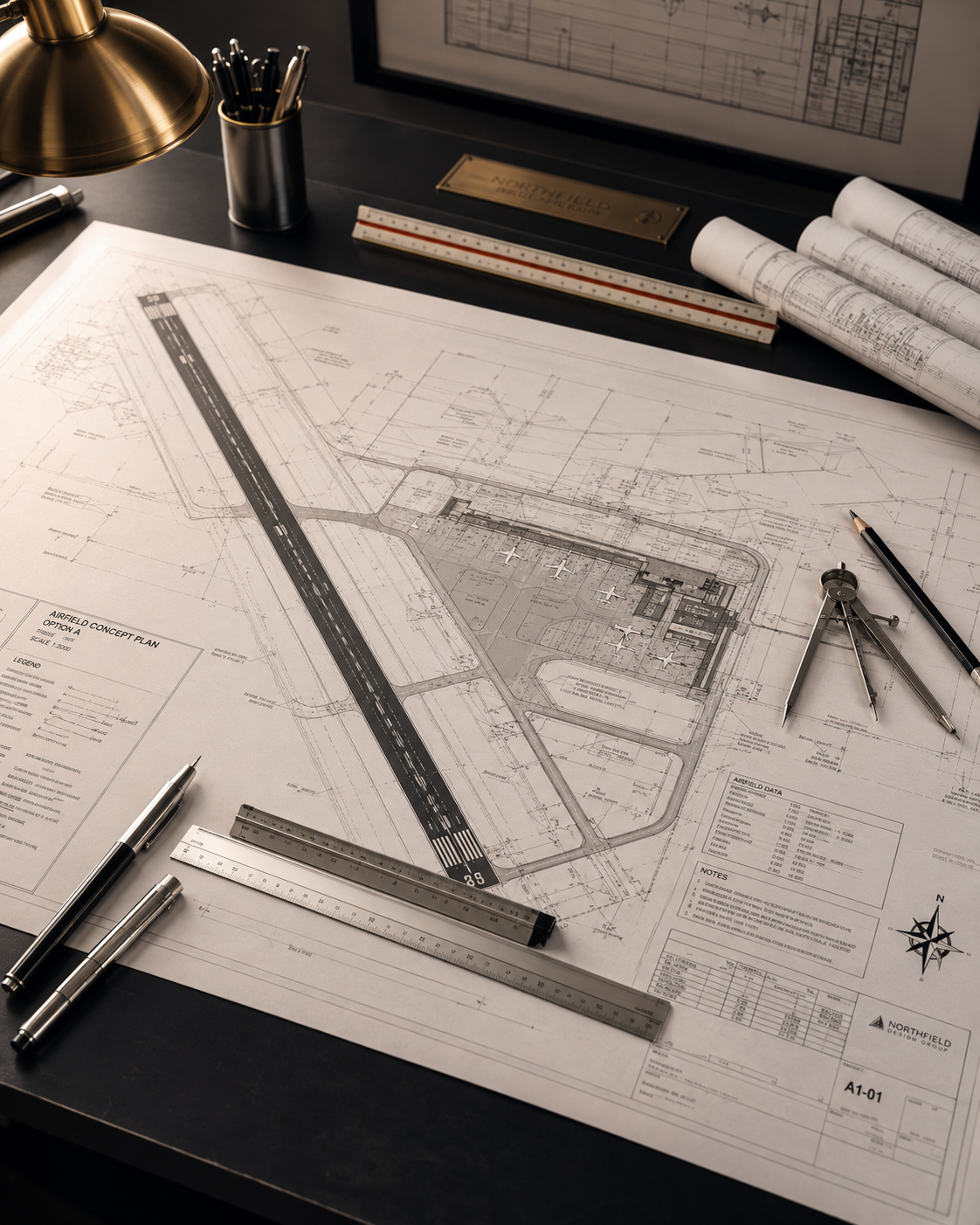
From Concept to Compliance Why Airfield Design Expertise Matters

The Compliance Conductor • August 13, 2026

Share this article

The Importance of Competent Designers in the design  phase for Airfield Lighting Infrastructure

Airfields are some of the most regulated, safety‑critical environments in the world. Every fitting, every circuit, every photometric value and every aspect on a plan has the potential for operational consequences.


Yet despite this, design quality is often underestimated.

Treated as a box‑ticking exercise rather than the foundation of long‑term airfield performance.

Airfield Design

The truth is simple: competent airfield designers protect airports from avoidable failures, unnecessary costs, and compliance exposure.


why airfield lighting design is not "just design."

Airfield lighting infrastructure design is fundamentally different from general electrical design. It requires:


  • Deep knowledge of ICAO, MOS 139, FAA, and AS/NZS 3000 and other applicable standards Airfield lighting is governed by strict photometric, electrical, and spatial requirements. A designer must understand not only the clauses, but the intent behind them.
  • Understanding of operational realities Taxiway geometry, aircraft movement patterns, apron stand layouts, and obstacle environments all influence lighting design. A competent designer blends theory with real‑world airside behaviour.
  • Integration of multiple disciplines Airfield lighting design touches electrical engineering, civil works, pavement interfaces, control systems, and even human factors. Poor coordination leads to costly rework.
  • Awareness of long‑term maintenance implications A design that looks good on paper can be a maintenance nightmare if pit locations, cable routes, or CCR loadings aren’t appropriately considered.


the risks of poor or inexperienced design

When design is left to generalists or rushed through procurement, airports inherit problems that may not surface until years later:

  • Value for money and lifecycle sustainability cannot be assessed accurately by the aerodrome operator.
  • Incorrect photometric performance leading to non‑compliance and inaccurate or unsafe visual cues.
  • Overloaded CCRs causing nuisance trips and premature transformer or circuit failures.
  • Misaligned or poorly spaced fittings that compromise pilot situational awareness.
  • Inaccessible pits and ducting that hinder maintenance and increase airside downtime.
  • Cable routes that conflict with future works, possibly forcing expensive relocations for airfield expansions.
  • Documentation gaps that make audits painful and upgrades challenging.

These issues aren’t theoretical. They’re common across airports that have previously relied on inexperienced designers or generic consultants.


competent designers build airports that last

A truly competent airfield designer does far more than sketch lines on a plan, they orchestrate the entire performance of the aerodrome. They deliver clause mapped, audit safe documentation where every element is traceable, valid, and aligned with the standards that keep regulators satisfied and operators protected.


Their lighting layouts aren’t just compliant; they’re tuned for optimal photometric coverage, sharper pilot visibility, and smarter energy use. They design with foresight, ensuring today’s infrastructure can gracefully accommodate tomorrow’s taxiways, LED transitions, and evolving regulatory expectations.


By considering maintenance realities from the very first concept, they help airports avoid premature failures, unnecessary civil works, and the creeping costs that come from short sighted design. And because they understand how airside works are actually delivered, their communication with contractors is clear, practical, and grounded in operational truth. Thus, turning design intent into reliable, constructable outcomes that stand the test of time. 



Why Airports Should Prioritise Design Competence

Airports operate in a world where safety margins are thin and regulatory scrutiny is high. Investing in competent design is one of the most cost‑effective decisions an airport can make.

It ensures:

  • Safer operations
  • Smoother construction
  • Fewer surprises
  • Lower long‑term costs
  • Guaranteed compliance
  • Better performance from every lighting asset


In short, competent design is the foundation of a reliable, resilient, and compliant airfield.


HOW AUSTRALIAN AIRPORT LIGHTING STRENGTHENS COMPLIANCE ASSURANCE

To support aerodrome operators in achieving performance and grant funding compliance, Australian Airport Lighting has developed a 30-Point Airfield Lighting Compliance Checklist which consists of a practical, audit-ready tool used across Australia and the Pacific on all our projects.


This checklist helps operators:

  • Validate photometric performance against ICAO, MOS 139, and FAA requirements
  • Confirm suitable electrical loading, CCR configuration, and circuit integrity
  • Ensure pit, ducting, and cable routing meet long-term maintenance expectations
  • Demonstrate compliance for grant-funded works, protecting funding eligibility
  • Identify design gaps early, before they become construction or operational issues


For airports seeking confidence, clarity and compliance certainty, our 30-point checklist is one of the most effective tools available, and a direct reflection of the commitment to raising the standard of airfield lighting design across the region.


FINAL THOUGHTS

Airfield lighting is infrastructure too critical to leave to chance. When airports choose designers with genuine airfield expertise, they’re not just building an airfield. They’re investing in the security of operational confidence for decades.

While Australian Airport Lighting do not provide design services, we work closely with reputable designers with a proven track record and can direct you to professionals with the right expertise to support your project effectively.

Recent Posts

An airplane is landing on an illuminated runway.
August 3, 2026
Learn what AGL construction means, why it matters for NSW airports, and how Australian Airport Lighting delivers compliant solutions. Contact us today!